Recent updates seem to suggest the character is now non-binary with a new design compared to the UTAU version.Idk if they're planning to change this but Ryone Yami is male and an otokonoko.
Recent updates seem to suggest the character is now non-binary with a new design compared to the UTAU version.Idk if they're planning to change this but Ryone Yami is male and an otokonoko.

And this is what it means to tune even further beyond!telepathy is a sh1tpost song (well its mv is, Miku turning into goku is quite silly) ofc its popular

Even if you're deep enough in the fandom that these articles won't reveal anything new, I consider them worth a read!And with platforms consolidating around YouTube and TikTok, global connections have naturally become part of the landscape. Amala’s “DaiDaiDaiDaiDaikirai” (No. 7), conceived as a successor to “Mesmerizer” and again featuring Hatsune Miku and Kasane Teto, also highlights how the pair are often portrayed as opposites, a depiction that may stem from their differing origins as a Vocaloid and an UTAU-born voicebank. The internet memes and the layers of sentiment that have accumulated around these virtual singer characters can themselves function as a force that broadens the expressive range available to them.


 I like that you wrote your impressions also here!

Oh, sorry! I didn't see that. I meant that it's the first year that Miku Expo allowed non-Miku Vocaloids.hehe yes, there is the Miku Expo 2026 thread about it:
https://vocaverse.network/threads/miku-expo-2026.10222/post-61083
but don't worry
I'd like to add one thing about the contest: the rule about accepting all Piapro characters has been in the Magical Mirai contest in the last few years as well, in fact Magical Mirai 2024 winner song, "Superhero", was featured by Len!

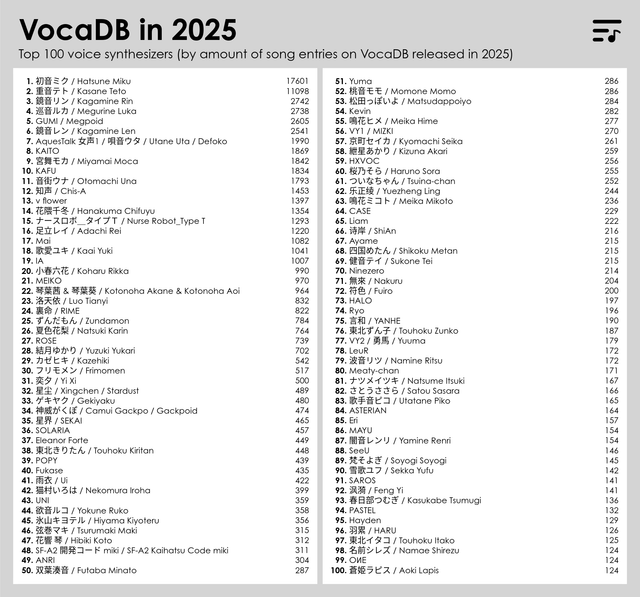
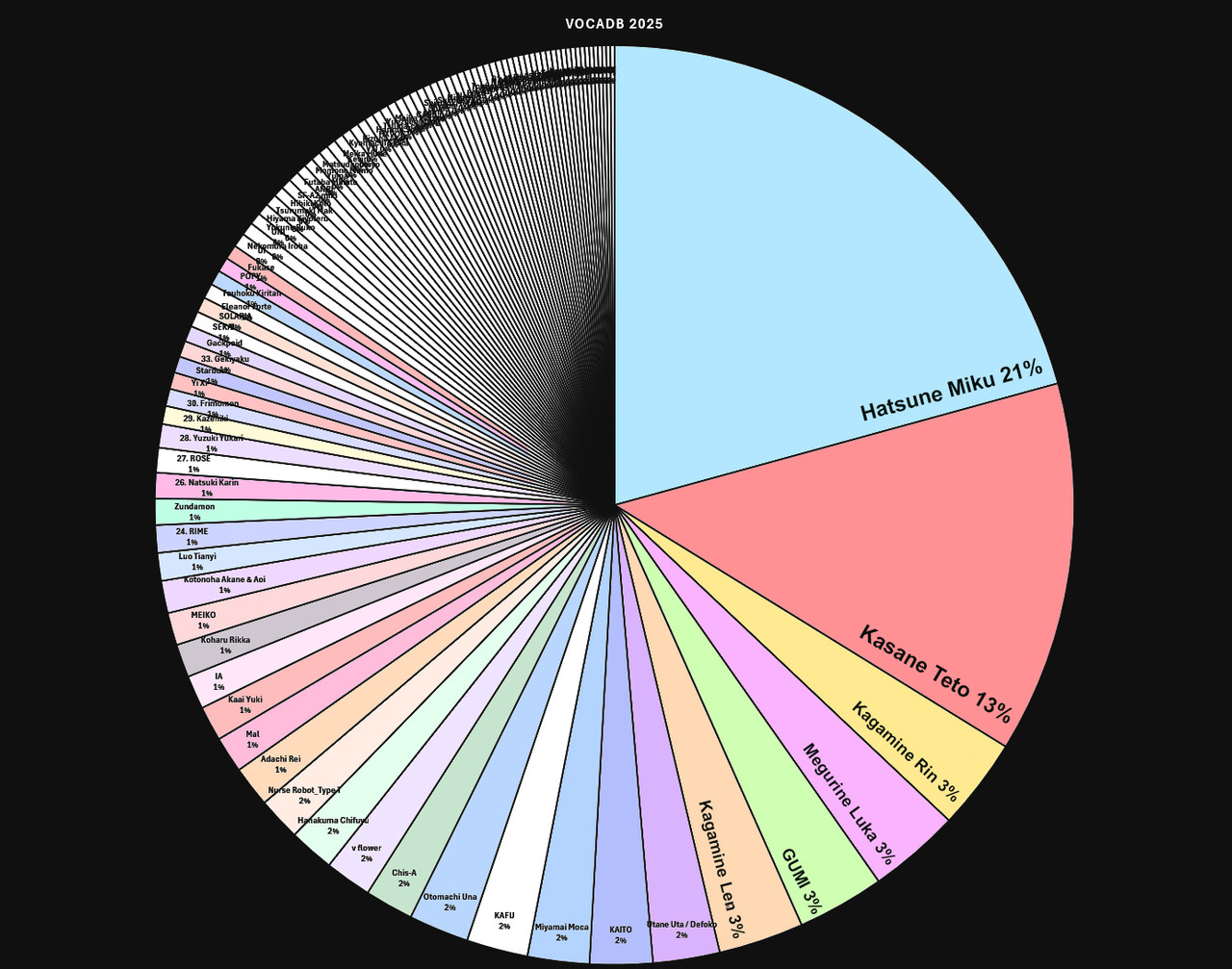
What the heck is Luka doing up there?! She's not that popular, is she? And above GUMI? Something seems wrong with these readings...VocaDB has also released their Top 100 vocal synths by song pages added to the database this year, I thought it would be interesting to turn it into a giant pie chart.
It's striking how evenly divided most of the chart is, the majority of vocal synths making up similar percentages. Miku and Teto are vast outliers to a distant third place.


You're right to be a little confused! I'll quote what I said in the SynthV Discussion thread about VocaDB statistics, as it still applies:What the heck is Luka doing up there?! She's not that popular, is she? And above GUMI? Something seems wrong with these readings...
I am fairly certain that Megurine Luka is overrepresented on VocaDB, because her ranking does not correlate with any of the recent Vocacolle rankings, where she isn't even in the top 15. It's unlikely that Luka users are simply abstaining from Vocacolle en masse: so what this probably indicates is that Luka is more popular with English speakers (VocaDB users) than with Japanese producers. This means Luka songs have a higher likelihood of being documented on VocaDB. On the opposite end of the spectrum, vocal synths like Nurse Robo, Zundamon, and Chis-A are very popular with Japanese producers, but little known among English fans. This causes their songs to be less well documented on VocaDB, resulting in a VocaDB ranking that is out of sync with the number of songs created using them. It's important to remember that every VocaDB entry is added manually, by a fan or power user.Caveats:
- VocaDB relies not just on a vocal synth's popularity among producers, but the popularity of a vocal synth among VocaDB editors. As such it cannot be considered a perfect correlation to the overall popularity of any vocal synth.
- Being a primarily English site, it's biased in favour of vocal synths with strong English-speaking fandoms. Obvious examples are the inflation of Megurine Luka's popularity, and Luo Tianyi being critically under-documented.
- A single productive editor can boost the number of entries for a particular vocal synth.
Enjoy!Oh. Well that makes sense! Also SHE PERFORMED AT THE LITERAL OLYMPICS?!?! WHY DID I NOT KNOW THAT BEFORE THAT'S SO COOL!


 It depends a lot on how the engine was built, and because Vocaloid2-4 has basically WAV audio source files for the voicebanks, it's faster for render because the audio is already there, no need to extra processing, while with newer engines, it can take more time because the voicebank is built differently and there is more work to do CPU side, just compare the setup size of any V2 and V6 voicebank: usually it's 1-2GB (or more, for V2), but for V6 is less than 100mb on average.